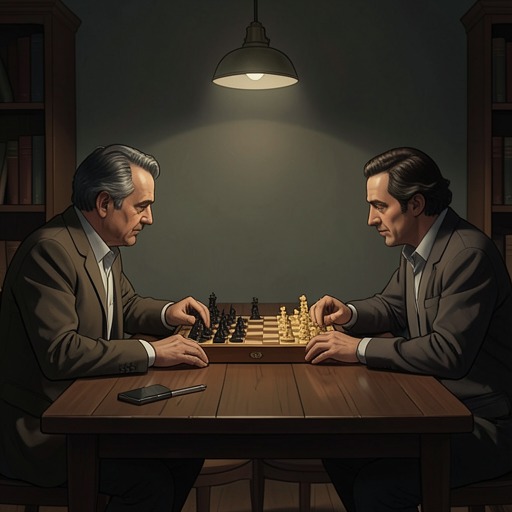
Jiro and Ogata-San's clash over education and old values
A Pale View of HillsJiro and Ogata-San's clash over education and old values grows out of a relationship that is courteous but not uncomplicated. During Ogata-San's visit, small exchanges about an old schoolmate lead to a larger disagreement over whether loyalty and inherited educational ideals sustain social life or preserve damaging beliefs. Jiro rarely confronts his father at length: he delays writing to Shigeo Matsuda, answers cautiously, and eventually ends one discussion by going to bed. The contrast between Ogata-San's insistence and Jiro's restraint makes their difference in outlook visible without dissolving their filial bond.
Identity and Family Contrast
Etsuko recalls the two men as physically unlike one another. Jiro is a small, stocky man with a stern expression, fastidious about his appearance and often dressed in a shirt and tie even at home. At meals he sits hunched forward over the table, a posture he also carries into standing and walking. His father, by contrast, sits with his shoulders thrown back and has a relaxed, generous manner. When he visits that summer, he is robust and energetic, apparently in the best of health. Etsuko's description establishes a difference in bearing as well as appearance: the son seems contained and tightly composed beside the father's ease.
Ogata-San stays for several days in the small square room at Jiro and Etsuko's home. Their exchanges take place among ordinary domestic routines—breakfast, supper, a game, and Etsuko's sewing—rather than in a formal confrontation. That setting matters to the relationship: the dispute surfaces within shared family life, while gestures of hospitality and the habits of conversation keep it from becoming an open rupture.
Shigeo Matsuda and the Question of Obligation
Over breakfast, Ogata-San asks whether Jiro will see Shigeo Matsuda at a school reunion. Jiro corrects the timing, explaining that the reunion is the following evening, and the conversation turns to whether he and Matsuda still meet. Jiro says that they see one another only occasionally now and have gone separate ways as they grew older. Ogata-San treats the reunion as a chance to renew former allegiances. In his view, people should not be quick to forget old ties, and looking back can help them keep events in perspective. He urges Jiro to attend.
That appeal to shared history acquires a more pointed purpose later. During a game, Ogata-San asks whether Jiro has written to Matsuda. Jiro says he has not, although he has meant to, and attributes the delay to being busy with work. Ogata-San accepts the explanation without pressing him, then returns to the subject after the game has continued. He hopes Matsuda may reconsider and apologize, and imagines that a reminder of personal obligations could make him do so. He suspects Matsuda wrote his article while preoccupied with communist books, rather than pausing to consider the consequences. The letter thus becomes more than a postponed piece of correspondence: for Ogata-San, it could restore a moral order in which loyalty and personal duty guide a younger man back toward an older teacher's position.
Jiro does not openly reject his father's request, but his repeated reference to work keeps the matter at a distance. Ogata-San responds with patience, saying that Jiro's work must come first and returning to the game. Their politeness softens the exchange without resolving it. The uncompleted letter marks the limit of Ogata-San's influence: he can urge, explain, and wait, but Jiro has not acted on the appeal.
Education, History, and Postwar Values
The tension becomes explicit when Ogata-San defends the educational system he helped maintain. He describes the Americans as having dismantled a system Japan had nurtured and cherished, replacing it with schooling modeled on American schools. In his account, the Japanese welcomed this transformation under the language of democracy, and valuable parts of the old schools were lost. His complaint reaches beyond institutional change. He believes discipline and loyalty once held Japan together, binding people to family, superiors, and country, while talk of democracy can become a way to evade obligations.
Jiro acknowledges that the old system had faults. He recalls being taught that Japan was created by the gods and that the nation was divine and supreme, lessons pupils had to memorize word for word. His example challenges his father's nostalgia with a concrete memory of nationalist education. Jiro does not deny that something may have been lost, but he refuses to treat the old curriculum as an uncomplicated inheritance worth restoring.
Ogata-San answers that the history of education cannot be reduced to those lessons. He says that he and other teachers devoted themselves to passing on what they considered proper qualities, and worries that children now receive no values at school beyond selfishly demanding what they want. He imagines a boy returning home to find his parents arguing because his mother refuses to vote for his father's party. In this example, the household becomes a miniature of the social transformation he fears: democratic disagreement, once admitted into family life, appears to him as a breakdown of shared discipline.
Jiro's response remains measured. He concedes that his father's concern may have some force, but earlier he has already named the defects in the education he received. Ogata-San, in turn, insists that the matter is more complicated than Jiro assumes and invokes his own work, alongside Endo's, to defend the effort to preserve what was good in the country. Their disagreement is therefore not simply between a father who values tradition and a son who rejects it. It concerns what should count as the valuable inheritance: collective duty and national cohesion, or an honest recognition that some supposedly unifying teachings were false and harmful.
Restraint, Attachment, and Significance
The pair's manner of disagreement reveals an asymmetry. Ogata-San returns to his arguments, explains them at length, and presses Jiro to remember old allegiances. Jiro gives brief replies, mentions his workload, yawns, scratches his face, and finally says he must go to bed. His restraint avoids a direct quarrel, but it also leaves his father's hopes unanswered. The gap between Ogata-San's expansive speeches and Jiro's limited responses is itself part of their conflict: the father wants assent or action, while the son does not offer either in the scenes recalled.
Nor is their relationship defined only by argument. Ogata-San's questions about Jiro's old schoolmate and his patient return to the letter suggest an effort to guide his son through a matter he considers consequential. Jiro continues to share the domestic space and the game with him, even as he resists the conclusion his father draws from Matsuda's article and from educational change. Etsuko also recalls that Ogata-San does not force the discussion on the evening he first considers raising it; he and Jiro are tired, read newspapers, and speak little. Courtesy, care, and disagreement coexist, with none entirely canceling the others.
Because the exchanges are presented through Etsuko's recollection, the relationship emerges through observed conduct rather than a direct account from either man. A question at breakfast, an unwritten letter, a game interrupted by talk of duty, and Jiro's eventual withdrawal give the ideological dispute its domestic scale. Their conflict records a generational divide in postwar Japan: Ogata-San fears that democracy and educational reform have severed obligations, while Jiro's memories show why restoring the old system cannot be a simple answer. The filial bond persists, but it does not produce agreement about which parts of the past deserve to be carried forward.